

A company needs resources to develop, but its needs change depending on its stage. Some projects require funding to expand an operation that already works. Others need to define their product, validate demand, and build a team. Understanding the venture studio vs traditional fund comparison helps distinguish what each model contributes.
Contents
Both can participate in business growth, although they do so from different positions. A venture studio usually takes a direct role in building the business. A venture capital fund selects companies to invest in and may support them with advice, connections, and strategic guidance.
The main difference lies in how participation is structured, the responsibilities each party assumes, and the capabilities the company receives.
What is a venture studio?
A venture studio is an organization dedicated to repeatedly creating and developing companies. It may generate ideas internally or work with entrepreneurs to turn an opportunity into a business.
Its involvement may include market research, product design, technology development, recruitment, sales and marketing, and operational planning. To do this, it typically maintains shared capabilities that it uses across different projects.
Building from the earliest decisions
Before an established company exists, someone must investigate the problem, define the customer, and determine whether the proposal makes sense. In this context, building companies starts with identifying opportunities, but turning those opportunities into viable businesses requires testing, validation, and execution.
For example, identifying difficulties in property management may lead to a technology solution. The subsequent work requires understanding users’ processes, developing an initial version, and checking whether they are willing to use and pay for it.
Sharing capabilities across projects
A shared team provides access to specialists without requiring the company to fill every necessary role from the outset. However, sharing resources also requires setting priorities.
It is useful to clarify how much time each specialist will dedicate to the project, who will supervise their work, and when a dedicated team will be needed. Actual availability matters as much as the list of services offered.
What a venture capital fund contributes
In this comparison, “fund” refers to a venture capital fund. Other types of funds have different objectives and ways of operating.
A venture capital fund pools resources from investors and allocates them to companies that fit its strategy. It may specialize by sector, location, stage of development, or investment size.
Selecting companies and funding their development
The fund analyzes opportunities and decides where to invest. It evaluates factors such as the team, market, product, investment terms, and potential returns.
The company usually has a founding team responsible for running the business. Funding may enable it to hire staff, develop technology, or expand commercial activity. Capital allocation should address specific needs, with objectives that allow its use to be assessed.
Providing support after investing
A fund’s involvement may include business connections, recruitment support, strategic guidance, and collaboration on future funding rounds. To assess that support, it is useful to identify which capabilities the company lacks and how the partner can provide them.
The study On resource complementarity among startups, accelerators, and financial investors: A large-scale analysis of sorting and value creation examines how complementary resources between entrepreneurs and investors influence value creation. Its findings show that business support from accelerators is particularly useful for teams with strong technological capabilities and less business knowledge. When evaluating a fund, this perspective helps clarify which expertise, connections, or specialized support the team needs to develop the company.
Venture studio vs traditional fund: key differences
The distinction should be examined through how each organization operates. Some venture studios have investment structures, while some funds have operational support teams. The model’s name should therefore be accompanied by an explanation of its resources and responsibilities.
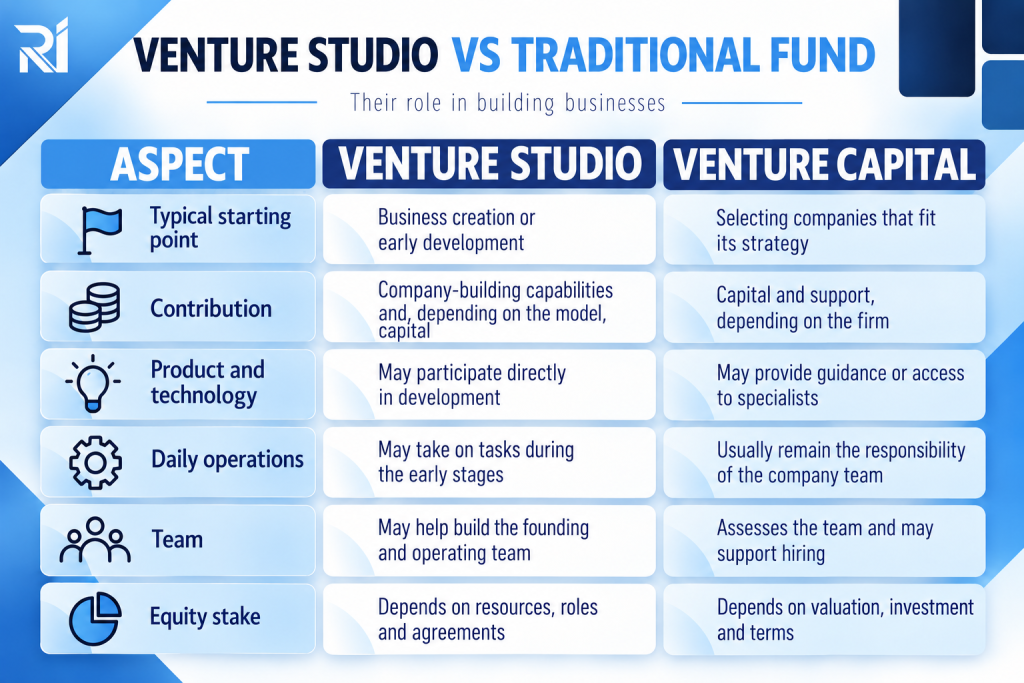
Capital, technology, and strategy
A financial contribution can fund activities, but the company needs people capable of carrying them out. A studio may organize part of that execution; a fund may finance it and help find the necessary resources.
The comparison should specify what is provided, who carries it out, and for how long. A promise of technology support may mean developing the product, advising on suppliers, or introducing candidates. These are different contributions, with different implications for the budget and organization.
Responsibility and autonomy
Intensive operational involvement requires coordination between the venture studio and the founders. It should be clear who makes decisions about the product, budget, recruitment, and commercial priorities.
With a fund, day-to-day management usually remains with the executive team, although oversight mechanisms and decisions governed by agreements may apply. In both models, defining responsibilities from the outset reduces uncertainty and facilitates collaboration.
How to assess what the project needs
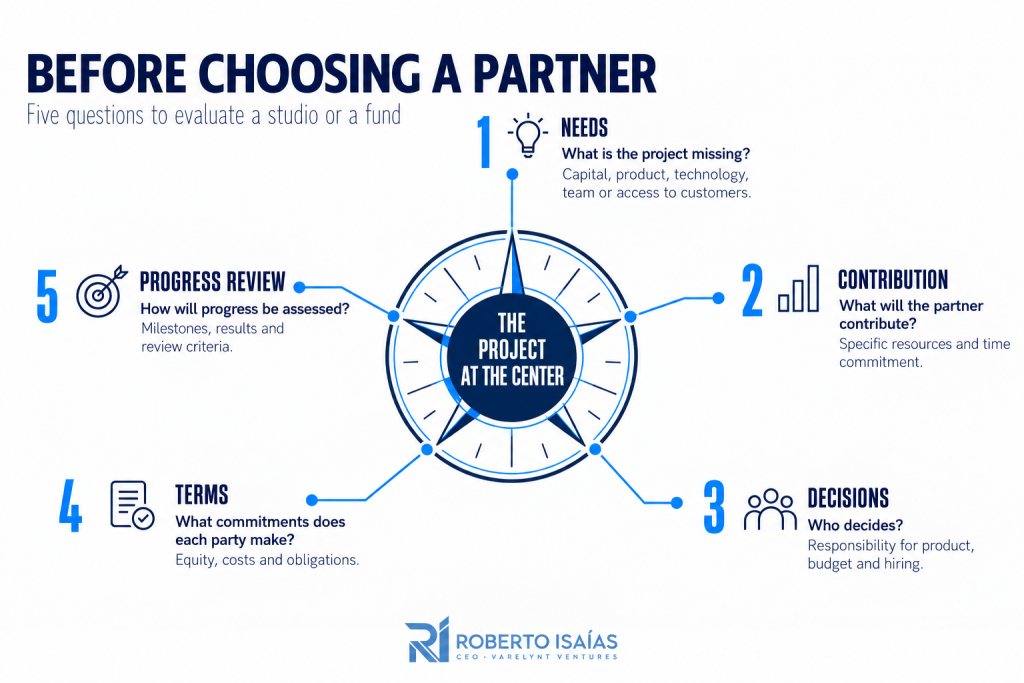
The choice begins with an assessment of the business. Does a product exist? Are there customers? Which capabilities are missing? Is the main challenge financial, commercial, or technical?
It is also useful to anticipate how the next stage will be financed. The EIF Equity Survey 2025, based on responses from 1,201 venture capital and private equity fund managers, identifies financing and liquidity as the main challenges facing startups in their portfolios. When evaluating a partner, useful questions include whether it reserves capital for subsequent investments, which other investors it works with, and what progress it would require before participating in another round.
When the ability to build is missing
An early project may need research, design, and development before it is ready to expand its activity. A venture studio may be suitable if its capabilities match those needs and it has sufficient resources.
It is useful to review examples of its work, team availability, and resource allocation criteria. It should also be clear how responsibilities will be transferred when the company hires its own professionals.
When an existing operation needs funding
A company with a product, team, and demand may need capital to expand sales or service capacity. A fund may be a good fit if its strategy and expectations are compatible with the business.
It is also necessary to assess how much growth the operation can sustain and which results would justify further investment. Hiring or increasing commercial spending requires checking that the company can meet the additional demand.
Validating before committing more resources
Neither model eliminates uncertainty. Having funding or specialists does not demonstrate that demand exists.
Before increasing the budget, it is useful to define which problem the proposal solves, why customers would choose it, and how much they would be willing to pay. These hypotheses make it possible to design tests whose results help inform decisions.
The study Does a theory-of-value add value? Evidence from a randomized control trial with Tanzanian entrepreneurs found better economic performance among entrepreneurs who combined hypotheses about their businesses with testing, compared with those who received training focused on evidence. Connecting each test to a specific hypothesis helps interpret the results and decide what to adjust before committing more resources.
Agreeing on milestones and reviewing results
Milestones should reflect meaningful learning: confirming a need, observing recurring use, or assessing willingness to pay.
Completing tasks is not the same as validating a business. Launching a website or developing an application demonstrates execution; understanding customer responses makes it possible to decide whether to continue, modify the proposal, or stop the project.
Building a relationship that fits the business
The venture studio vs fund comparison is useful when it translates into questions about resources, responsibilities, and objectives. It is also worth anticipating how the relationship will change when the company builds its own team or seeks additional funding.
Within Roberto Isaias’s business context, this distinction provides a way to approach company creation by considering capital, technology, strategy, and operations. Choosing a partner requires understanding how its contributions fit the project’s needs and how they will be put into practice.
FAQ about venture studios and funds
Yes. Some combine funding with operational capabilities. The specific contribution depends on their structure and agreements.
Yes. It may provide guidance, connections, and specialized support. It is useful to check the scope and availability of that support.
There is no universal answer. It depends on the project, team, resources provided, and terms of collaboration.
Yes. Both may participate at different stages or coexist, depending on the company’s structure and needs.
Available resources, time commitments, responsibilities, equity ownership, costs, and shared objectives. The proposal should explain how the promised support will be delivered.