

Applying artificial intelligence in business starts with understanding how work gets done. Before choosing a tool, it is useful to identify which tasks consume time, where errors occur, and what information the team needs to make better decisions.
Contents
A company may use AI to classify requests, prepare drafts, or analyze documents. However, each application requires different objectives and evaluation criteria. Saving minutes on a task only adds value if the output maintains quality and makes subsequent work easier.
From a business perspective such as the one Roberto Isaias explores, the relevant question is which process can improve and how that improvement will be measured.
Identifying processes where AI can add value
The starting point is to observe operations. Repetitive tasks, waiting times, and frequent searches for information can reveal opportunities. It is also useful to listen to the people performing those activities: they understand the exceptions and difficulties that a general process description may overlook.
Separating tasks from job roles
A job combines different activities. A customer service employee may answer routine questions, investigate issues, and negotiate solutions. Each task requires a different level of context and judgment.
The 2025 report Generative AI and Jobs: A Refined Global Index of Occupational Exposure, from the International Labour Organization and NASK, identifies job transformation as the most likely effect of generative AI, because many tasks still require human involvement. For a company, this directs attention toward which parts of the work can receive support and which need human oversight or execution.
For example, a system can prepare a response to a frequently asked question. Resolving a complaint involving specific circumstances may require a person to review the case and agree on a solution.
Prioritizing by frequency, difficulty, and results
An opportunity deserves attention when the problem occurs frequently, consumes resources, and allows the company to assess whether the intervention works.
It is useful to start with a clearly defined process. Classifying internal requests may be more manageable than trying to automate the entire sales support function. A specific scope makes it easier to identify errors and compare results.
Distinguishing automation, analysis, and decision support
Artificial intelligence includes technologies with different functions. A model that generates text does not serve the same purpose as a demand forecasting system.
Understanding these differences helps companies choose tools based on operational needs rather than popularity.
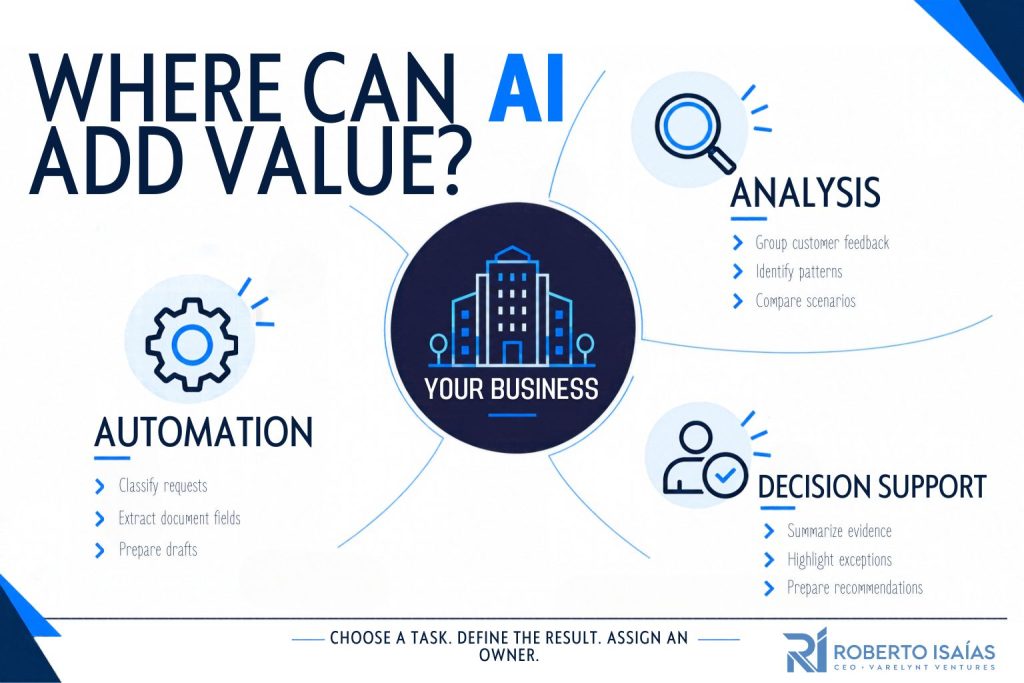
Automating tasks with clear inputs and outputs
Automation works best when the required information, expected outcome, and response to exceptions are clearly defined.
Possible applications include extracting fields from documents, classifying messages, or preparing summaries for review. In other cases, a conventional rule may solve the task more simply. The solution should fit the problem.
The 2025 study Shifting Work Patterns with Generative AI, available through Microsoft Research, found changes in individual activities such as email and document creation, but no significant reduction in time spent in meetings. This difference shows why each activity should be evaluated separately: a tool may make individual work easier without resolving the team’s coordination challenges.
Analyzing information to inform decisions
AI can also help explore customer feedback, identify patterns, or produce forecasts. Its usefulness depends on data quality and whether the analysis answers a specific question.
Before using an output, it is useful to review its sources, limitations, and the conditions that could change it. A recommendation needs context, especially when it affects budgets, customers, or commercial priorities.
Preparing data and defining responsibilities
A trial may look promising and encounter difficulties when introduced into operations. Outdated documents, unclear permissions, or scattered information can reduce the system’s reliability.
Preparing an implementation requires reviewing both the data and how work is organized.
Organizing available information
If an assistant answers internal questions, it needs current, accessible sources. If it analyzes sales, it requires comparable records and consistent criteria.
The company should also define which information may be used and who can access it. The team needs to know where to enter data, how to review responses, and whom to contact when an issue arises.
Assigning a process owner
Each application should have someone responsible for reviewing its performance. That responsibility includes monitoring outputs, resolving exceptions, and deciding when to modify or suspend its use.
It is also useful to establish which outputs require approval before use. An internal draft may need a straightforward review; a contractual communication requires a different level of control.
Testing before expanding implementation
A demonstration shows possibilities. An operational trial determines whether those possibilities fit the business.
The relationship between technology and execution is also part of how artificial intelligence is changing how companies are built. Introducing it requires observing what changes in daily work and which resources the team needs to benefit from it.
Comparing results against a baseline
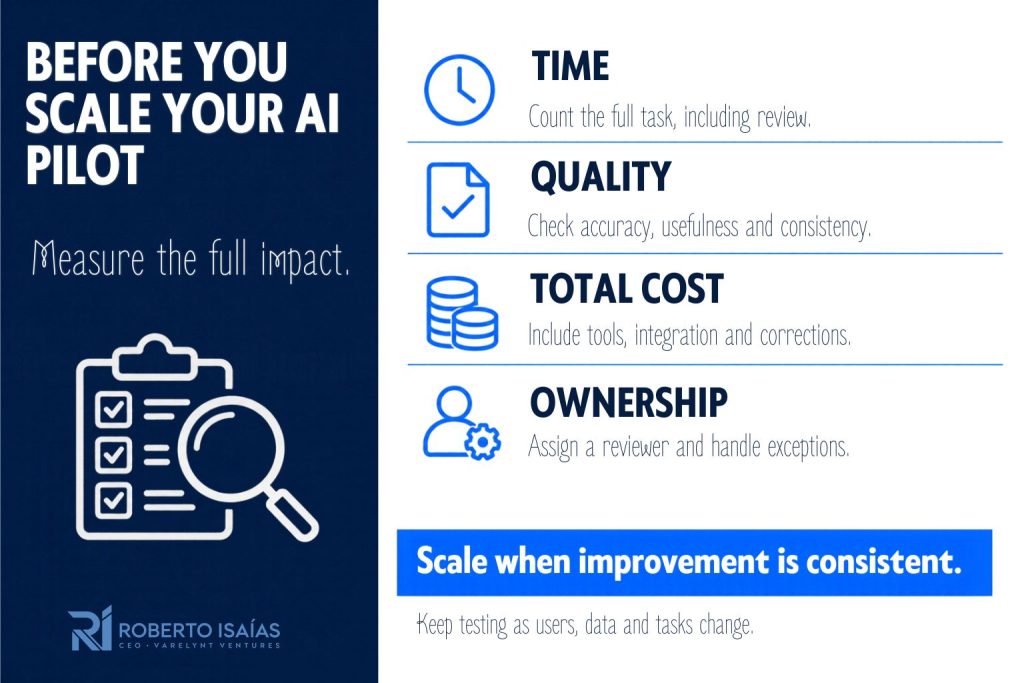
Before starting, it is useful to record how long the process takes, how many errors it produces, and how much review it requires. A sample of tasks completed with and without the tool can then be compared.
The indicators should include time, quality, and total cost. A faster response may offer little value if it subsequently requires extensive corrections.
Checking limitations in real cases
Tests should include routine situations and exceptions. It is also important to observe what happens when information is missing or a request is ambiguous.
Stanford HAI’s 2025 AI Index Report documents advances in model capabilities while noting that complex reasoning remains challenging. This combination makes it necessary to evaluate the tool using examples from the business itself, rather than assuming that results on general benchmarks guarantee reliable performance on every task.
Integrating AI into business operations
When a trial produces useful results, the next step is to incorporate the tool into the workflow. It should be clear when it is used, how the output is delivered, and what happens if the system fails.
Training the team with specific tasks
Training should teach employees how to provide context, review responses, and recognize when another procedure is needed. Practicing with common examples helps identify questions before expanding use.
Expanding based on evidence
A positive result justifies gradual expansion. Each expansion may introduce users, documents, or situations that were absent from the initial trial.
In Roberto Isaias’s business content, technology adoption can be approached through this relationship between opportunity and execution. Artificial intelligence adds value when it improves an identifiable process and the company can sustain that improvement through data, people, and ongoing monitoring.
FAQ about artificial intelligence in business
With a frequent, clearly defined, measurable task. It is useful to understand the problem and expected outcome before selecting a tool.
No. Some tasks can be handled through rules, forms, or conventional integrations. The choice depends on the process’s variability and complexity.
By comparing time, quality, errors, review requirements, and costs before and after implementation. The indicators should reflect the project’s objective.
That depends on the company’s needs, data, and integrations. An existing tool may be sufficient to test the use case before considering custom development.
When the trial demonstrates a consistent improvement, responsibilities are assigned, and the team can manage exceptions without compromising quality.