

To identify business opportunities, watch what people do when a tool falls short, a task gets delayed, or a process forces them to repeat work. A spreadsheet someone updates every night or a message that has to be forwarded to three people may reveal more about a need than an enthusiastic response to a product idea.
Contents
- How to identify business opportunities in everyday problems
- What separates a recurring problem from an isolated complaint
- What alternatives do customers already use?
- What to ask to understand why a customer would switch
- Which opportunities are worth investigating first?
- How to turn an observation into a business hypothesis
- Frequently asked questions about identifying business opportunities
In the business approach of Roberto Isaias, building companies starts with that kind of observation. This guide follows a hypothetical example: a property manager receives maintenance reports by phone, email, and messaging apps. Before proposing a platform, she needs to find out where time is lost, who is affected, and what would persuade the team to change how it works.
How to identify business opportunities in everyday problems
Start by shadowing someone as they complete a task. Ask them to show you what they do from the moment they receive a request until they close it. Watch for when they look up information, switch tools, wait for a response, or need to ask someone else what happened.
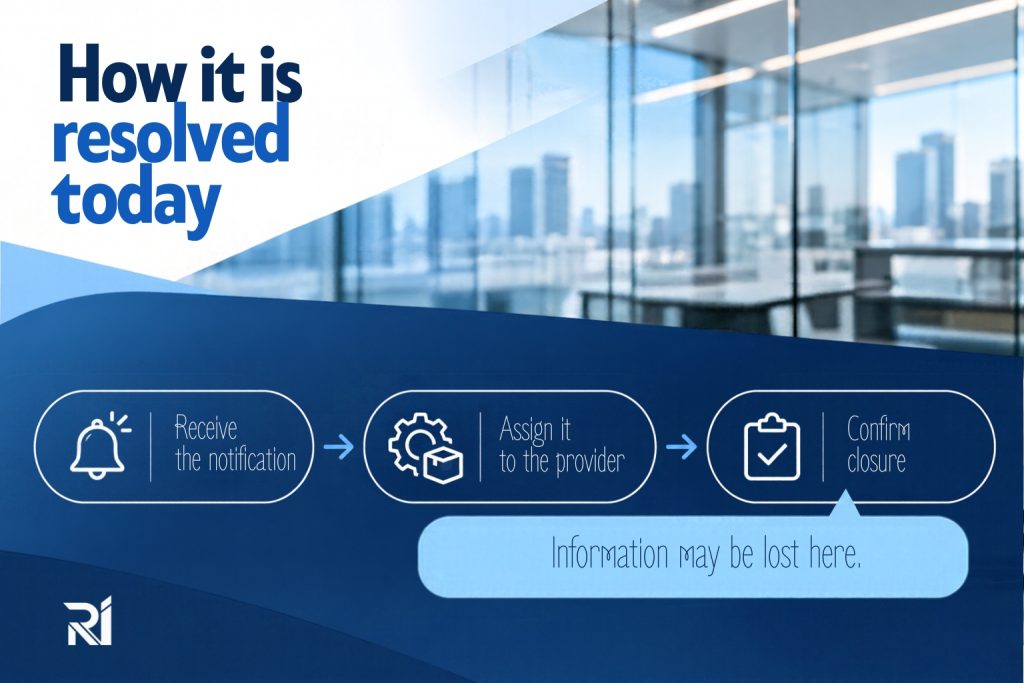
For the property manager, receiving reports through multiple channels may seem like the main problem. But tracing one maintenance request reveals another difficulty: the contractor confirms by phone that the job is done, and the person who deals with residents never gets that update. The team has no reliable way to tell which requests are still open. Bringing incoming messages into one place might make them easier to log while leaving the tracking problem unresolved.
In your notes, separate what you observed from what you think explains it. “The property manager called twice to confirm the job was done” describes a behavior. “She needs to automate those calls” is an interpretation. Keeping the two separate lets you compare cases without assuming you already know the solution.

What separates a recurring problem from an isolated complaint
A complaint can point to something worth looking into. To tell whether it represents an opportunity, look for comparable incidents within a specific customer segment. Ask when it last happened, how often it occurs, and what consequences it has. A rare failure that halts an important activity may deserve more attention than a daily annoyance that takes seconds to resolve.
The Federal Reserve Banks’ 2026 Report on Employer Firms: Findings from the 2025 Small Business Credit Survey found that reaching customers and growing sales was the operating challenge most often cited by the small businesses surveyed. That finding can guide your questions, but it is too broad to define a product. One business may lose sales because it gets too few inquiries. Another may lose them because it takes too long to respond. A trend tells you where to look. Specific cases tell you what to investigate.
In the property management example, compare firms with similar portfolios and teams. If several lose confirmation that a job is complete at the same point in the process, you have an initial pattern. If it happens with only one contractor, find out what makes that contractor different before broadening your hypothesis.
What alternatives do customers already use?
A new solution may compete with a combination of familiar tools. The property manager might use messaging apps to receive photos, a shared spreadsheet to log requests, and the phone to deal with urgent problems. That setup has advantages: residents know how to use it, and contractors do not have to install anything.
Trace the work it takes to keep that setup running. Who copies the data? Who checks whether the contractor replied? What happens when the person who normally follows up is away? That work can go unnoticed because it is part of the routine.
The 2025 study Experimentation in “everyday” small business ventures, which looked at 20 small food and beverage businesses, documented how some experiments arose spontaneously in the course of everyday work. Although it focuses on a different industry, it offers a useful interview prompt: ask what changes customers have already tried on their own. An extra column in a shared spreadsheet or a weekly reminder may show which part of the process they have tried to improve.
What to ask to understand why a customer would switch
Ask the person you are interviewing to describe the last time they had the problem. What did they do first? Who did they ask for help? What had they tried before, and why did they stop using it? If you can look at a record or an anonymized example, compare it with their account. Asking about recent events reveals more about behavior than asking, “Would you use this app?”
Also speak with the person who uses the tool, the person who approves the purchase, and anyone who would have to incorporate it into their daily work. Administrative staff may want a shared view of maintenance requests. Management may prioritize cost. Contractors may balk at having another account to manage. In a small company, one person may fill several of those roles, but the considerations still differ.
The 2026 case study The Double Pivot analyzed 148 interviews from a university healthcare AI venture. Purchasing preferences and budget constraints led the team to rethink its target segments. The case suggests a practical question for discovery interviews: What would need to happen within the company for a user’s interest to turn into a purchasing decision?
Which opportunities are worth investigating first?
Compare opportunities by how often the problem occurs, how much it costs, and how easily you can reach the people affected. If two problems seem equally costly, start with the one whose process you can observe and whose decision makers are willing to explain how they make choices. That will help you find out sooner whether you understood the difficulty correctly.
Suppose the property manager identifies two needs: confirming that maintenance requests are closed and comparing repair quotes. If the first problem comes up every week and can be traced using existing records, it offers a clearer starting point. The second can stay open until you have enough examples to understand how bids are compared.
This prioritization reflects how venture building works: the problem you choose to investigate shapes which customers you interview, what skills the team needs, and which resources make sense to commit.
How to turn an observation into a business hypothesis
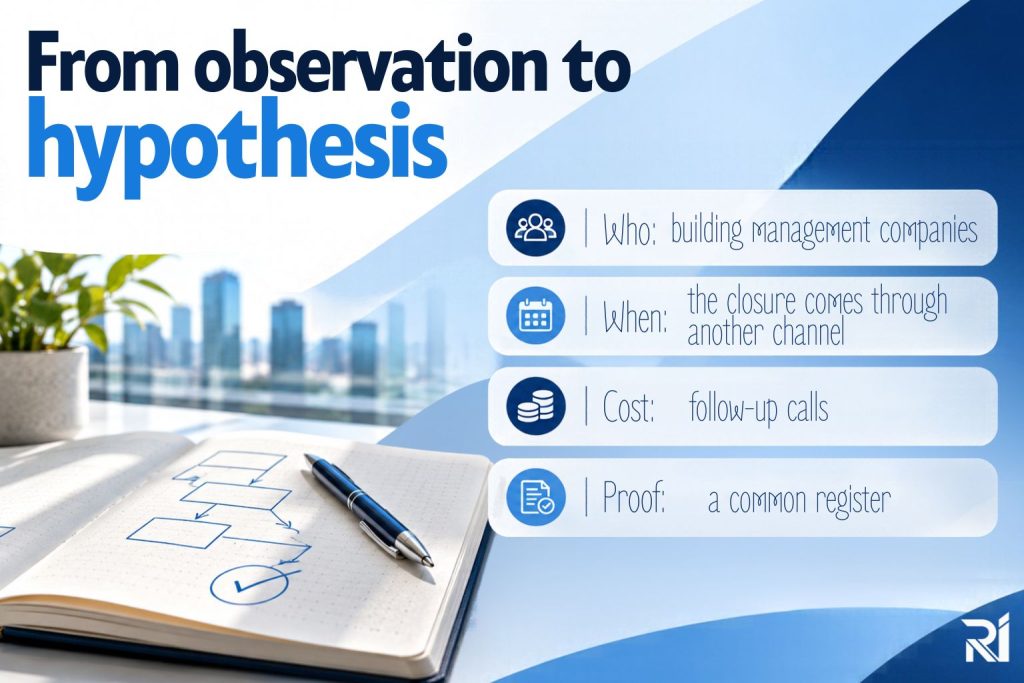
Write one sentence that states who has the problem, when it arises, and what it costs them. For example: “At small property management firms that work with several contractors, staff spend time checking which requests are still open when job completion is reported through a different channel from the original request.”
Next, write down what observation would change your mind. If other property managers keep reliable records and rarely call to confirm that jobs are done, the difficulty may be specific to one firm. If the pattern repeats and staff spend time on it each week, try a small test. For example, share a completion log with one contractor and see whether follow-up calls decrease.
A useful hypothesis tells you what to check before deciding what to build. If the problem is confirmed, you still need to determine who would develop the solution and who would fund the work. Comparing venture studio vs fund helps clarify those responsibilities when the time comes.
Frequently asked questions about identifying business opportunities
How can I tell a business opportunity from a simple annoyance?
Look for comparable incidents and observe what customers do to resolve them. If they already spend time, money, or staff effort on the problem, you have a reason to investigate. You still need to find out whether they would switch to another solution and under what conditions.
Do I need a product idea before interviewing customers?
Start with a specific task and customer segment. Ask interviewees to show you how they work today. That gives you a basis for deciding whether to develop a tool, offer a service, or test a change to the process.
When should I test demand?
Do it when you can describe the problem, identify who makes the purchasing decision, and ask for an action that provides evidence, such as joining a pilot or accepting a specific offer. To get started, pick a problem you have observed and write down who has it, when it arises, and how they deal with it today.